
Matthew De Furio
- Research Fellow
- Astronomy
Contact Information
Research
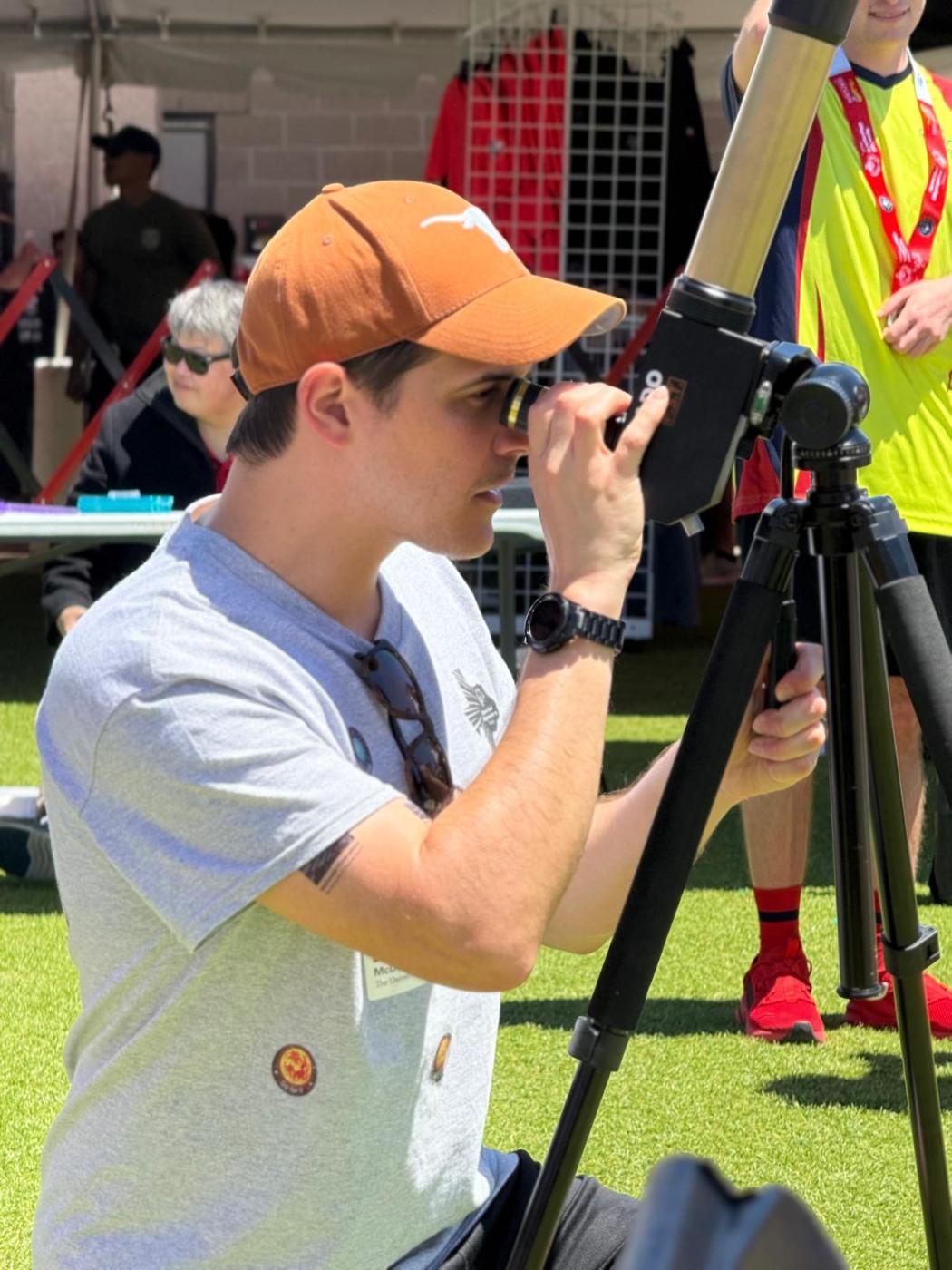
Matthew De Furio is an NSF Astronomy and Astrophysics Postdoctoral Fellow at UT Austin. He competed his PhD in Astronomy and Astrophysics at the University of Michigan - Ann Arbor in 2023. He is an expert in star and brown dwarf formation with a focus on multiplicity and high-contrast and high-angular resolution imaging techniques. Dr. De Furio is a member of the James Webb Space Telescope (JWST) NIRCam and NIRISS science teams, and he leads several Hubble Space Telescope (HST), JWST, Keck, Gemini, and CHARA programs to explore free floating planets, the fundamental limits of the star and planet formation process, and stellar and sub-stellar multiplicity. He has served as a research mentor and supervisor for several undergraduate students working on HST and JWST data. Outside of his research capacity, Dr. De Furio teaches astronomy based courses through Lifelong Learning with Friends, a non-profit organization providing post-secondary education for adults with intellectual and developmental disabilities.
Education
- PhD in Astronomy and Astrophysics from the University of Michigan - Ann Arbor in 2023
- MS in Astronomy and Astrophysics from the University of Michigan - Ann Arbor in 2019
- BS from the University of Florida (Major: Physics, Astronomy; Minor: Mathematics) in 2016
Publications
Select Publications:
De Furio M., Faherty J., Bardalez Gagliuffi D., et al. (2025) ApJL: Discovery of the Second Y+Y Dwarf Binary System: CWISEP J193518.59-154620.3
Mehta K., De Furio M., Bardalez Gagliuffi D., in press, AJ: The Hubble Ultracool Multiplicity (HUM) Survey. I. Characterizing Sensitivity to Companions at Sub-Diffraction Limit Separations with HST WFC3/IR
De Furio, M., Ygouf, M., Greenbaum, A., et al., (2025), Proc. SPIE 13627, Techniques and Instrumentation for Detection of Exoplanets XII, 136270L: Wavefront error recovery and companion identification with the James Webb Space Telescope
De Furio M., Gardner T., Monnier M. et al. et al. (2025), ApJ: The Small Separation A-Star Companion Population: Tentative Signatures of Enhanced Multiplicity with Primary Mass
De Furio M., Meyer M.R., Greene T. et al. (2025), ApJL: Identification of a Turnover in the Initial Mass Function of a Young Stellar Cluster Down to 0.5 MJ
Calissendorff P., De Furio M., Meyer M.R. et al. (2023), ApJL: JWST/NIRCam Discovery of the First Y+Y Brown Dwarf Binary: WISE J033605.05-014350.4
De Furio M., Lew B., Beichman C. et al. (2023), ApJ: JWST Observations of the Enigmatic Y-Dwarf WISE 1828+2650. I. Limits to a Binary Companion
De Furio M., Liu C., Meyer M.R. et al. (2022), ApJ: Demographics of the M-star Multiple Population in the Orion Nebula Cluster
De Furio M., Gardner T., Monnier M. et al. (2022), ApJ: The Small Separation A-star Companion Population: First Results with CHARA/MIRC-X
De Furio M., Meyer M.R., Reiter M. et al. (2022), ApJ: Binary Formation in the Orion Nebula Cluster: Exploring the Substellar Limit
De Furio M., Reiter M., Meyer M.R. et al. (2019), ApJ: A Search for Intermediate-separation Low-mass Binaries in the Orion Nebula Cluster
De Furio M., Ahn S.J., Burne R.A., Hagen S.J. (2017), Appl Environ Microbiol: Oxidative Stressors Modify the Response of Streptococcus mutans to Its Competence Signal Peptides
Awards
- NSF Astronomy and Astrophysics Postdoctoral Fellowship